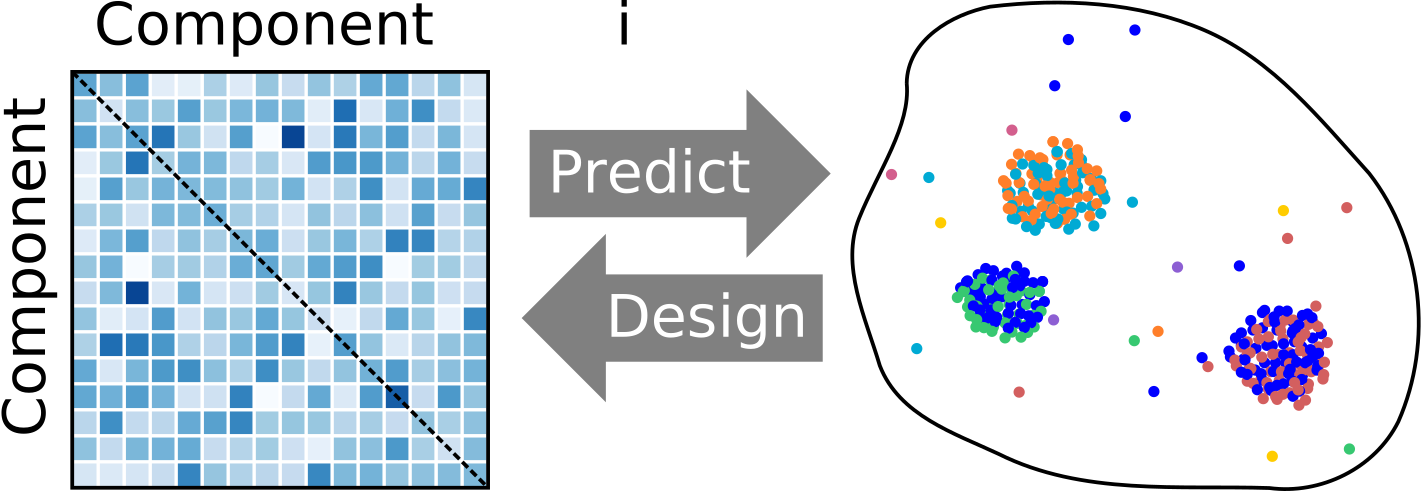
The phase behavior of a mixture with many components can be extremely rich: Multiple phases with distinct compositions and material properties can coexist, share components, and assemble into higher-order structures. Studying multicomponent phase behavior is important for understanding self-organization inside living cells, where many proteins and nucleic acids have been observed to segregate reversibly into phase-separated biomolecular condensates.
We develop computational methods to design and coarse-grain phase-separating mixtures using tools from optimization theory, information theory, and machine learning. Insights derived from these approaches have implications for our understanding of biomolecular condensate assembly in living cells, as well as for the design of stimulus-responsive soft materials.
JACS 2025 | PRMaterials 2025 | JCTC 2024 | JCP 2023 | PRL 2021
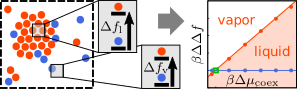
In living systems, phase separation can take place under nonequilibrium conditions as a result of driven chemical reactions or other dissipative processes. However, the driving forces and kinetics of phase transformations that occur at such nonequilibrium steady states cannot be described using the standard tools of equilibrium thermodynamics.
Our approach to this problem focuses on the connections between microscopic fluctuations and macroscopic phase behavior in nonequilibrium systems. We also study the extent to which equilibrium kinetic theories, such as those based on free-energy landscapes and transition states, can be applied to nonequilibrium phase transformations. Our work shows that a microscopic viewpoint is often required to quantitatively predict the conditions for phase coexistence and the rates associated with phase transformations taking place far from equilibrium.
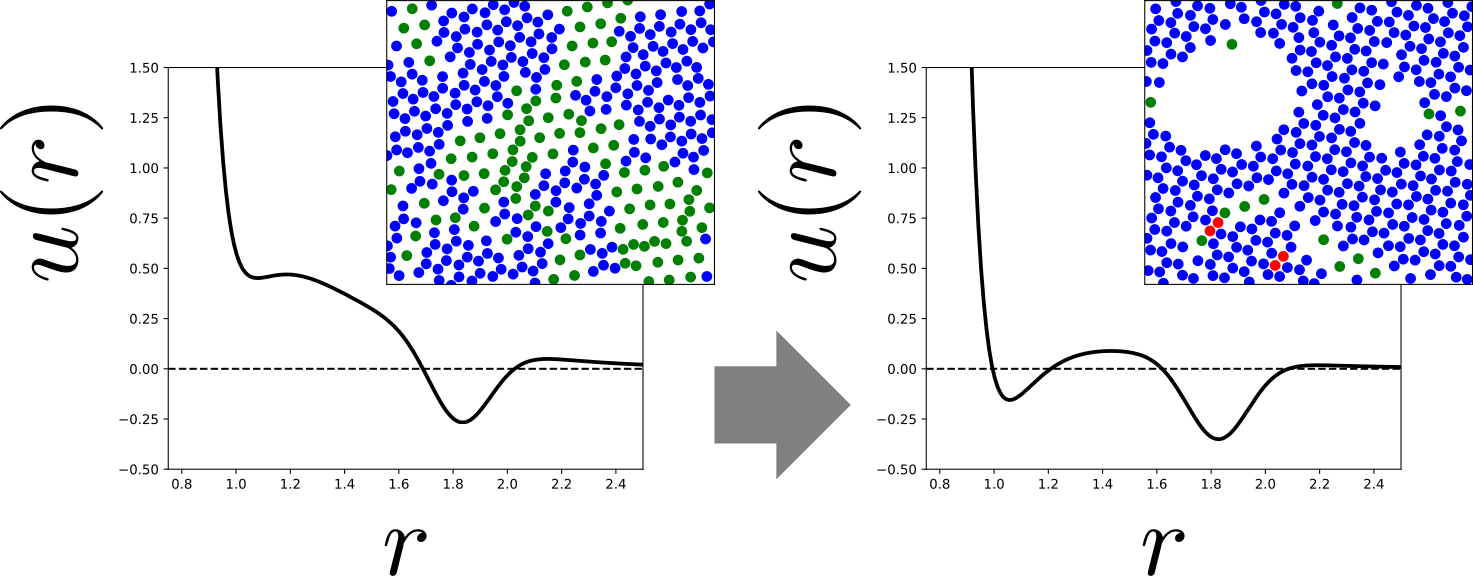
The success of a self-assembly process, judged by the time required and/or the yield of correctly assembled structures, can be extremely sensitive to the conditions under which self-assembly is carried out. Our group addresses this challenge by developing methods to predict kinetic assembly pathways from microscopic details. We also develop methods to design the interactions among subunits in a material such that the assembly kinetics are optimized for prescribed experimental conditions. These approaches enable us to maximize assembly yields, minimize errors, and choose among alternate structures that can all assemble from a single pool of subunits.
We apply our methods to a range of systems selected from both biology and soft materials engineering. These include prototypical examples of programmable materials, such as DNA nanostructures and DNA-functionalized colloidal crystals, in which a large number of components with specific interactions are used to create information-rich and multifunctional structures.
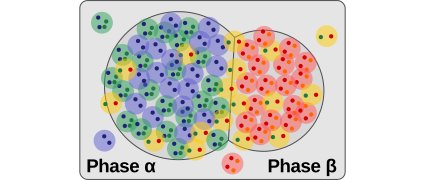
We apply multiscale theoretical approaches, blending molecular simulation and mesoscale modeling, to understand how specific interactions among proteins, RNA molecules, and chromatin control the interfacial properties of biomolecular condensates. These properties, in turn, direct the assembly of phase-separated condensates into higher-order multiphase structures and modify the kinetics of condensate assembly. We also apply coarse-grained theories and molecular simulations to investigate how protein and nucleic acid sequences dictate the phase boundaries and internal dynamics of biomolecular condensates.
PRX Life 2024 | MBoC 2024 | Science Advances 2024 | PRL 2024 | Cell 2020
